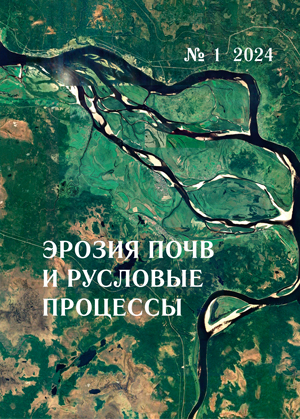
The journal "Soil erosion and river channel processes" covers the research of theoretical and experimental mechanisms of erosion and channel processes, manifestations of erosion and channel processes in various natural and natural-anthropogenic conditions, development of new methods of erosion control applied to various branches of economy and research on the effectiveness of various erosion control means. The journal is coordinated by the Interuniversity Scientific Coordination Council on erosion, channel and estuarine processes.
Current issue
Due to the agricultural transformation of landscapes, an increase in the rate of water erosion of soils is noted both at the global and national levels. In the CIS countries, water erosion is the most common type of degradation of agricultural land. Improving approaches to solving the problem of managing erosion-hazardous agrolandscapes involves the development of automated methods for assessing water erosion of a given spatial accuracy, taking into account all factors of land use.
The article presents the results of modeling the rates of water erosion at the regional level in the Brest region of the Republic of Belarus and the Belgorod region of the Russian Federation. A comparative analysis of the factors of erosion is given, including the example of the results of modeling water erosion in key areas. Global and local digital terrain models based on radar data, laser terrain scanning (lidar) data, and related software are taken into account when assessing topographic conditions. Based on calculations based on the model, potential soil losses due to stormwater erosion are estimated, including for different genetic types of soils – sod-podzolic and typical chernozems. The results obtained make it possible to determine the order of adoption of various, including expensive, measures to combat and prevent water erosion necessary to obtain sustainable crops while maintaining reasonable production costs.
Particle size differences between source and target samples distort source apportionment results in suspended sediment fingerprinting. The standard approach to eliminating this effect is the application of a weighting coefficient proportional to the specific surface area of particles (Wsum). Previous studies applied Wsum to all elements without exception. However, such a correction is valid only for elements whose concentrations are controlled by sorption onto particle surfaces and is not applicable to elements incorporated into mineral crystal lattices.
In this study, we propose a selective particle size correction algorithm in which the decision to apply the correction is made for each element individually based on two criteria: a significant positive weighted-mean correlation between element concentration and Wsum, and the geochemical affinity of the element (sorption-controlled or matrix-bound). The algorithm was tested using data from the Setun River basin (Moscow) collected during 2019–2023, including three source groups (surface soil, road dust, and river banks) and suspended sediment sampled at the river mouth as the target. In addition, weighting coefficients (Wsum) calculated using geometric and arithmetic mean particle diameters were found to be virtually identical (r = 0.99). R functions implementing the proposed correction algorithm have been made publicly available on GitHub.
The paper demonstrates that not all combinations of steepness and asymmetry parameters of riverbed dunes ensure their morphological stability. By comparing the “triangular” approximation describing the dune profile as a triangle and the dune profile approximation using a “sinusoidal” model (constructed by gluing two branches of a modified sinusoid), the influence of the approximation method choice on the permissible ranges of dune steepness and asymmetry parameter ratios is analyzed. It is established that the requirement of firstderivative continuity (profile smoothness) at the trough and crest points, implemented in the “sinusoidal” model, imposes stricter constraints on dune geometry. It is shown that the maximum local slope of the back slope in the sinusoidal profile significantly exceeds the average slope of the corresponding triangular model. Based on the condition that the dune surface inclination angle must not exceed the angle of repose of the material from which the dune is composed, analytical relationships are derived to determine the critical steepness and critical asymmetry for “triangular” and “sinusoidal” dunes. Combined stability nomograms are constructed, enabling identification of zones with physically impossible parameter combinations for various types of bed sediments. The results can be used to verify bathymetric survey data and improve calculations of channel hydraulic resistance.
mathematical model of the longitudinal profile of river dunes is proposed, based on the approximation of the stoss and lee sides of the dune by two sine wave branches with identical amplitudes but different periods and phase shifts. Unlike the triangular approximation, this model ensures profile smoothness (С1-continuity) at all characteristic points – at the crest and in the troughs – eliminating the singularity problem in hydrodynamic calculations. Analytical expressions are obtained to describe the profile both as a piecewise function and as a unified analytical function defined over the entire abscissa axis, which is convenient for use in theoretical models and numerical simulations. It is shown that the areas under the sine wave branches are exactly equal to the areas of the corresponding triangles formed by chords, allowing for the use of simple estimates for dune volume characteristics. For arc lengths expressed through elliptic integrals, numerical calculations were performed across a wide range of steepness and asymmetry parameters. It was established that the relative excess of the «sinusoidal» profile length over the «triangular» one is 2–4%, which can be significant in calculations of hydraulic resistance and sediment transport. Families of parametric plots describing the main geometric characteristics of the «sinusoidal» dune are constructed. The results obtained can be used for riverbed relief modeling, channel resistance assessment, and bedload discharge calculations.
For the first time, this article provides a comprehensive description of the channel regime of the Pur River and its tributaries, based on literature data, cartographic materials, analysis of satellite images, and field surveys, accompanied by cartographic representations. The map of the Pur basin shows the morphodynamic types of the riverbed, the composition of the riverbed-forming sediments, bank erosion as a reflection of horizontal riverbed deformations, the presence of shoals, the width and floodability of the floodplain, the development of floodplain multi-branching, and other parameters against the background of geological, geomorphological, and hydrological natural conditions. The Pur basin is characterised by high water-bearing capacity, wide floodplain channels and sandy composition of channel-forming sediments, which determines high sediment transport and the formation of sandy shoals. The features of channel formation and deformation, including the processes of straightening, branching, the formation of side channels and pools, are considered for the main rivers of the basin: the Pur, Pyakupur, Aivasedapur and their tributaries. The paper provides the first comprehensive morphological and dynamic characterisation of the Pur riverbeds, including the delta area, taking into account the influence of permafrost and the specifics of estuary processes. The results obtained are of practical importance for the development of northern territories, the planning of water management measures and the development of shipping, especially in the context of the development of Russia’s Arctic zone.
The issues of spatial distribution and depth of permafrost in the estuary bars of the Arctic rivers of the Russian Federation have been studied rather fragmentarily, which is due to the inaccessibility and complex hydrological conditions for conducting field studies. One of the least studied areas is the bar section of the Yana River at the mouth of the Glavnoye Ruslo shipping channel. The last successful studies of permafrost conditions on the Yana bar date back to the early 1970s, when drilling operations were carried out (from the ice), which allowed for the characterization of the structure and temperature regime of the bottom sediments in certain areas, including the bar furrows where the river flow is concentrated. In 2024, a complex of geophysical studies was carried out, including seismoacoustic profiling of the upper layer of bottom sediments, aimed at assessing the permafrost conditions within the Zamanikha navigable bar. At the same time, the results of profiling were verified using small-scale drilling. This article presents the results of summarizing archival materials and interpreting the data from the 2024 field studies, which allowed for the updating and refinement of the current background that determines the permafrost conditions in the studied bar area in the Yana Delta. Using GIS technologies, the spatial and depth distribution of permafrost and seasonally frozen soils along the shipping route was visualized and quantified.

ISSN 3033-9588 (Online)